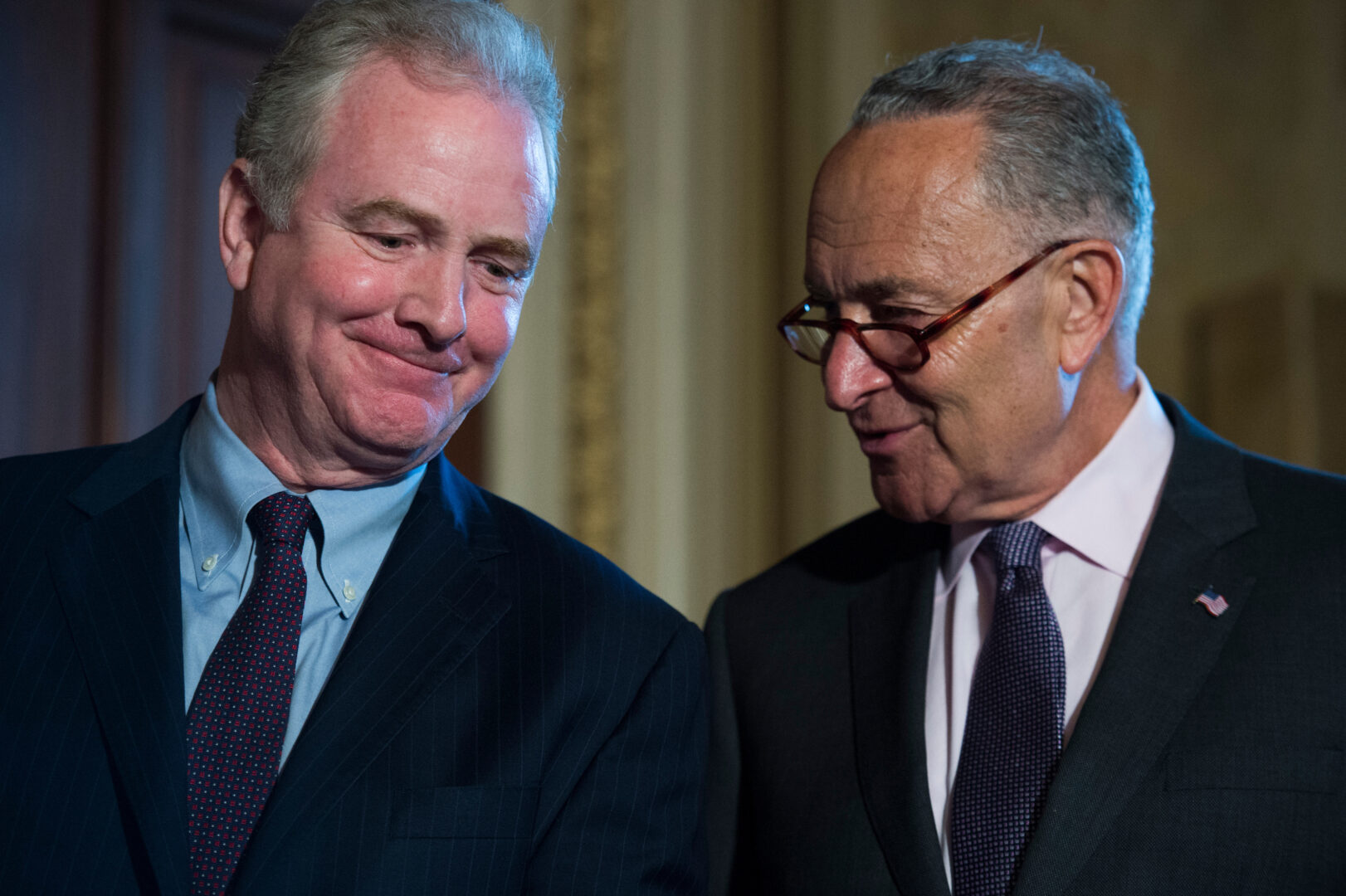
Chris Van Hollen’s challenge to Chuck Schumer puts a practical question before Senate Democrats: how should they use the power voters have just handed them? The Maryland senator announced his bid on November 12, after Democrats won control of both chambers of Congress. Schumer says he has the votes to remain leader. Reuters
The strongest evidence of what could change lies in specific decisions: whether to make restrictions on the Iran war a condition of government funding, how to handle arms sales to Israel, and whether the party’s Senate campaign committee should stay out of contested primaries.
On domestic policy, the dividing lines are less tidy. Some senators backing Schumer support measures Van Hollen also wants. Replacing the leader could change priorities and negotiating tactics, but delivering legislation would still require assembling a coalition, overcoming Senate obstacles and confronting President Donald Trump’s veto.
The first test comes before Democrats take control
Van Hollen has already put his name to a concrete funding demand. In a statement posted by his office on November 12, he joined Michael Bennet, Bernie Sanders and Tammy Duckworth in opposing a year-end spending package unless it restricts funding for Trump’s war in Iran. Their stated aim is to keep the government operating while stopping money from being used for the war. Joint statement
That position could force a difficult choice when current government funding expires on December 11. Republicans still control Congress until January. Democrats would therefore be negotiating with the outgoing Republican majority, with a partial shutdown possible if no agreement is reached. Roll Call’s funding report
Schumer also opposes the war. In July, he urged Republicans to support a war-powers resolution to end it. At his November 10 leadership press conference, he again identified ending the conflict as a Democratic objective. July floor remarks · November press conference
The immediate distinction is how far each would go in the funding negotiation. As Punchbowl News reported on November 13, Van Hollen was prepared to risk a shutdown over war funding, while Schumer had not specified his position on that confrontation. Punchbowl News
For voters demanding an end to the war, that is a meaningful difference. A funding condition gives opponents something specific to negotiate over. Its effectiveness depends on whether enough senators will maintain that condition when a deadline approaches—and whether the resulting legislation can become law.
Israel policy exposes a split—and an overlap
The Senate’s voting record offers a clearer comparison than campaign language.
On April 15, Van Hollen voted to advance a resolution disapproving a proposed arms sale to Israel. Schumer voted against advancing it. The motion failed, 40–59. This was a procedural vote on one proposed sale, rather than a final vote ending American military assistance. Senate roll call
Van Hollen has continued pressing for limits on military cooperation. In a November 10 letter, he and other senators asked congressional leaders to remove three provisions from the annual defense bill that would mandate expanded US–Israel defense and intelligence cooperation. The letter cited concerns about Israeli actions in Gaza and the West Bank. That request remains a policy demand; the letter itself changes no law. Letter to congressional leaders
Yet the leadership contest does not divide senators into two consistent camps on Israel. Tammy Baldwin and Angus King voted alongside Van Hollen on the April arms-sale motion. Both have endorsed Schumer for leader. Voting record · Their leadership endorsements
For readers concerned about Palestinian rights, that overlap matters. Van Hollen could give restrictions on arms transfers greater prominence in leadership negotiations. Whether such restrictions pass would still depend on senators’ votes on particular measures, including those who prefer Schumer as leader.
A narrower, testable pledge on AIPAC and primaries
Van Hollen has also proposed changes to the party’s political operation. According to Roll Call’s account of his MS NOW interview, he pledged not to take sides in contested Democratic primaries and to ensure that the Democratic Senatorial Campaign Committee, or DSCC, did not accept money from the American Israel Public Affairs Committee, known as AIPAC. Roll Call
The scope of that commitment matters. It concerns the Senate campaign committee, rather than every Democratic candidate or outside group. It should be assessed against the committee’s actual funding and conduct if he takes charge.
For candidates challenging the party’s preferred choices, neutrality could change their relationship with the national campaign operation. For readers trying to judge whether promises of reform amount to anything, this offers a measurable question: would the committee’s behavior change?
Health care complicates the argument for a clean break
Van Hollen’s announced priorities include restoring Medicaid funding cut in the 2025 budget law, extending Affordable Care Act tax credits and pursuing broader improvements in health-care affordability. He also called for a livable minimum wage and protection against households subsidizing data centers. His agenda, reported by Roll Call
Schumer has made affordability central to his own case. At his November 10 press conference, he also argued that data centres should pay their fair share and that local communities should be protected. Those statements establish overlapping priorities, although they do not settle what legislation either leader would prioritize or accept in negotiations. Schumer’s remarks
A specific bill illustrates how policy alliances cross leadership loyalties. On November 10, Baldwin introduced legislation allowing people aged 50–64 to buy into Medicare. Van Hollen is a co-sponsor. The proposal would expand access through a buy-in; it is neither an enacted benefit nor a universal Medicare program. Baldwin’s Medicare at 50 proposal
Baldwin’s support for Schumer, therefore, cannot be read as opposition to every health-care expansion associated with Van Hollen. The more useful comparison is which bills each prospective leader would bring forward, how hard they would bargain for them and what compromises they would accept.
That is also the distinction households will experience: an election victory changes who sets priorities, while legislation determines whose premiums, coverage or costs actually change. Growth Presto’s analysis of what the Democratic midterm victory could mean for the economy examines that gap.
Schumer’s supporters have a case—and the votes remain private
Schumer’s argument rests partly on the majority Democrats have just won and his ability to manage a diverse caucus. The Associated Press reports that he has been working with senators on an opening agenda covering health care, tariffs and the Iran war. His supporters include Sherrod Brown and Catherine Cortez Masto. Associated Press
Van Hollen has public backing from Sanders and Michigan Senator-elect Abdul El-Sayed. He says his supporters number more than ten, but that claim is not a verified ballot count. Nor is Schumer’s declaration that he has enough votes a completed election result. Punchbowl reports that the leadership election is scheduled for December 1. Punchbowl News
The decision belongs to the Senate Democratic Conference. Its rules provide for a secret ballot in contested leadership elections and require a majority of members present and voting. There is no subsequent confirmation vote by the full Senate. Conference rules
What neither leader can deliver alone
A majority leader has considerable influence over the Senate’s agenda and negotiations. But most contested legislation ordinarily needs 60 votes to end debate under the filibuster rules. A Democratic majority does not automatically supply that threshold. Congressional Research Service explanation
Even legislation that passes both chambers faces the president. Overriding a Trump veto would require two-thirds of members voting in each chamber, with a quorum present. The Democratic Conference’s own rules also explicitly protect members’ freedom to cast their votes independently of the leadership. CRS on veto overrides · Conference rules
Those constraints make the choice of leader consequential without making it all-powerful. Van Hollen could change the demands Democrats make and the risks they accept. Schumer could retain the job while facing pressure to adopt some of those demands.
The December 1 ballot will decide who leads. The December 11 funding deadline will provide an early opportunity to judge what that leadership is prepared to insist on.