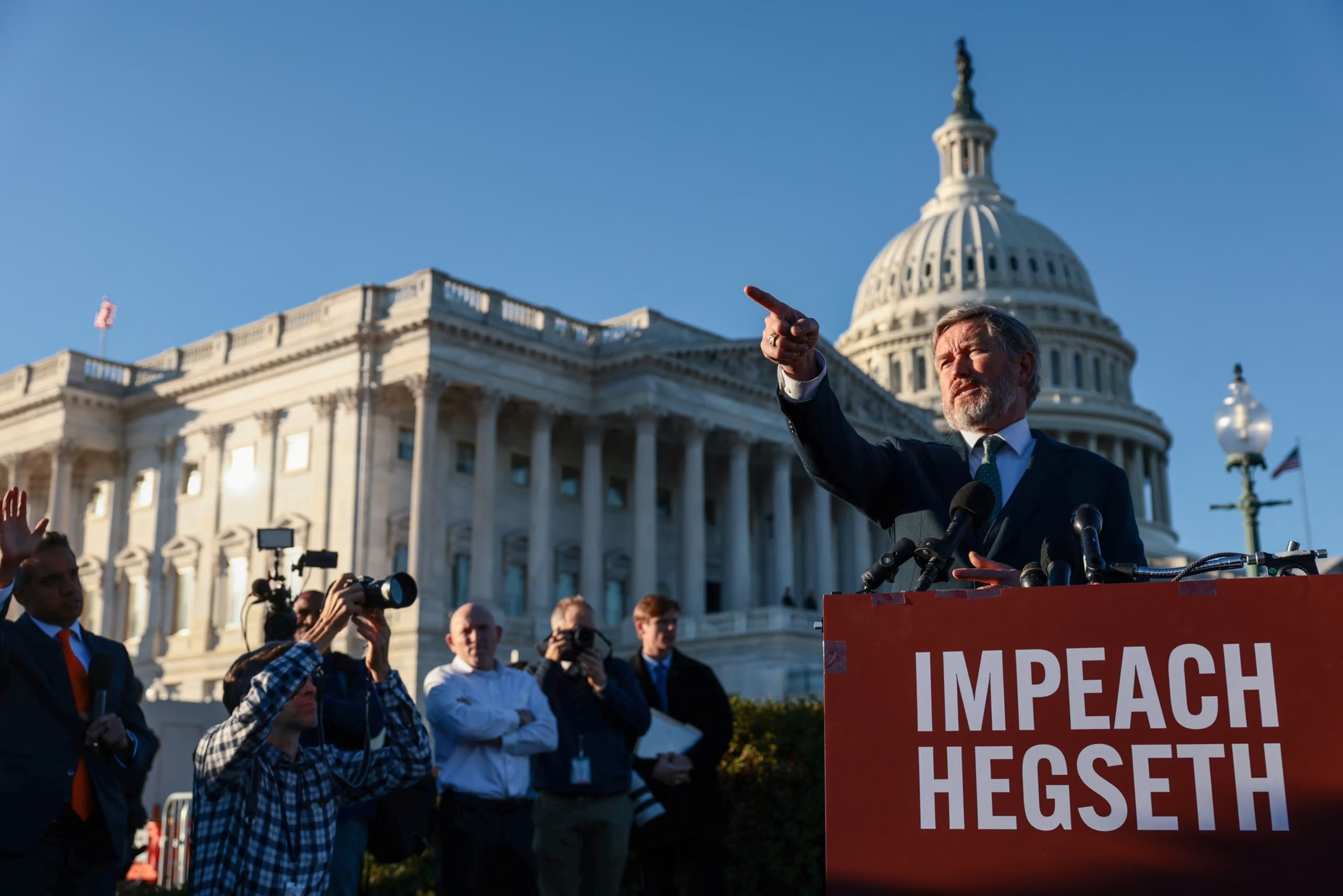
Pete Hegseth called the effort to impeach him a “political spectacle” at the Pentagon on November 10. A day earlier, Republican Representative Thomas Massie had brought eight articles of impeachment to the House, accusing the defense secretary of abuses that include conducting unauthorized war and undermining civilian protections. Hegseth says the operations were lawful and ordered by President Donald Trump. ABC News’s account of the briefing captures the confrontation. The substance requires a closer look.
Massie is right to demand that Congress confront these allegations. The public record warrants impeachment proceedings, disclosure and testimony. Hegseth’s response should be judged against the decisions he made and the safeguards his department maintained, rather than his willingness to defend Trump.
The schoolchildren killed in Minab belong at the center of that examination. Their deaths cannot be reduced to another argument about which American politician wins the next confrontation.
What Massie is asking Congress to confront
Massie’s November 9 announcement identifies three distinct war powers accusations: that the Iran war began without lawful authorization, that operations continued after Congress directed their termination and that hostilities persisted beyond the statutory withdrawal deadline.
The remaining articles concern civilian protections, lethal strikes against suspected drug traffickers, retaliation against Senator Mark Kelly, the seizure of Venezuelan leader Nicolás Maduro and military action in Yemen. Each allegation requires its own evidence. Supporting congressional action does not require treating every assertion in the resolution as already proved.
The deadline allegation is particularly important to understand. Under the War Powers Resolution’s termination provision, the president generally must end the covered use of armed forces within 60 days after the required report is submitted—or should have been submitted—unless a statutory exception applies. Those exceptions include congressional authorization or an extension enacted into law.
An additional period of up to 30 days is conditional: the president must certify that military necessity requires it for the safety of forces being withdrawn. It is not an automatic license for another month of offensive operations.
There is also a significant complication in the separate charge about defying Congress’s withdrawal resolution. A Congressional Research Service explanation notes that the Supreme Court’s 1983 decision in INS v. Chadha cast constitutional doubt on the mechanism allowing Congress to order withdrawal through a concurrent resolution, which is not presented to the president for signature or veto.
That complication deserves an answer. It does not settle the separate disputes about starting the war, exceeding statutory deadlines or protecting civilians.
Congress should require the administration to identify its legal authority for each stage of the campaign and explain how that authority applies to the operations it actually conducted. A broad assertion that the president ordered the war cannot do all of that work.
Minab is part of the impeachment case
Article IV of Massie’s resolution expressly addresses the strike on Shajareh Tayyebeh Elementary School in Minab. It alleges that Hegseth weakened legally mandated civilian protection systems and that those decisions contributed to the disaster.
That is a claim about leadership and institutional safeguards. It requires evidence connecting departmental decisions to failures in the targeting process.
Independent scrutiny already provides substantial grounds for investigation. In its March investigation, updated in April, Amnesty International concluded that the United States carried out an unlawful strike and failed to take feasible precautions against civilian harm. Its analysis drew on imagery, video and interviews. Satellite images showed that the school had been physically separated from the neighboring military compound years earlier.
Amnesty acknowledged that restrictions on access and communications prevented it from independently verifying the death toll.
The UN’s Independent International Fact-Finding Mission on Iran reported on September 17 that more than 150 people, including approximately 120 girls and boys, were killed at the school. It found reasonable grounds to believe that the US attack amounted to the war crime of making a civilian object the target of an attack.
That is a serious investigative finding. It is not a criminal conviction of Hegseth or proof that he personally selected the school as a target. Establishing individual responsibility requires examining what particular officials knew, ordered, approved or failed to prevent.
Precision here serves the victims. An accusation that outruns the evidence gives officials an opportunity to dispute the exaggeration while avoiding the documented failures.
Nor does a claim that children were not intentionally targeted end the inquiry. As Human Rights Watch explains, the questions include precautions, target verification and whether conduct was sufficiently reckless to establish criminal responsibility under the applicable legal standard. A civilian casualty incident is not automatically a war crime; describing a strike as a mistake does not automatically resolve those questions either.
The investigation should be in the public record
Congress has already sought the evidence.
On July 13, 25 senators demanded the Pentagon’s complete investigation, a version suitable for public release and a plan to prevent another such attack. Their letter raised concerns about reported failures to update targeting information. The senators explicitly treated those underlying reports as matters requiring verification.
In October, Senator Kirsten Gillibrand renewed her demand following reporting that Pentagon officials intended to delay disclosure until after the midterms.
As of its November 9 account of the impeachment effort, Stars and Stripes reported that the Pentagon had still not released the findings.
This is a concrete obligation Congress can pursue regardless of the impeachment outcome. Lawmakers should obtain the underlying records, examine any legitimate reasons for withholding specific information and insist on a meaningful public account. Families should not have to depend indefinitely on anonymous descriptions of an investigation into their children’s deaths.
Hegseth’s defense leaves the central questions open
Hegseth’s November 10 defense has two principal elements: that the operations were lawful and that the impeachment effort turns policy disagreements into accusations of misconduct. He also portrayed the effort as threatening American troops. ABC News reported those arguments, alongside Trump’s defense of his secretary’s war record.
The policy-disagreement argument deserves consideration. An unpopular campaign or an election defeat alone cannot establish that a cabinet official committed an impeachable abuse.
Massie’s allegations, however, concern specific limits on government power and the systems intended to protect civilian life. Answering them requires legal arguments and evidence about decisions. Calling the accuser resentful provides neither.
The attempt to make this a test of loyalty to troops is especially unconvincing. Congressional examination of civilian leaders can help establish whether service members received lawful direction, adequate intelligence and functioning safeguards. Those are responsibilities that senior officials owe to the people they command.
Trump’s support also cannot resolve the case. Growth Presto’s earlier examination of Hegseth’s position after the midterms addressed the risk of concentrating responsibility in one subordinate. The impeachment inquiry should follow decisions through the chain of command, including the White House.
What the next vote can—and cannot—do
The House’s immediate action may be procedural. Roll Call explains that Massie’s use of a privileged resolution can lead to consideration of the articles, a motion to table them or referral to a committee. A vote to table would shelve the resolution. A committee referral would leave further action to that process.
An impeachment vote would require a simple House majority. It would bring formal charges; it would not immediately remove Hegseth.
The Constitution requires two-thirds of senators present to convict in an impeachment trial. With all 100 senators present, that means 67 votes. Impeachment proceedings also remain separate from any criminal prosecution.
Republicans still control the outgoing Congress. Democrats’ election victories give them majorities when the next Congress begins in January, as Stars and Stripes reports. That changes the political setting for oversight, but a Senate majority alone does not meet the conviction threshold.
Readers should therefore examine the exact motion and recorded votes before accepting claims that Hegseth has been impeached, cleared or removed.
What accountability must produce
Congress should judge its work by what it establishes and changes. Four tests follow from the record:
| Question | What a meaningful answer requires |
|---|---|
| What authorized the Iran operations? | The administration’s legal rationale, reporting dates and explanation of how it complied with congressional limits. |
| How did the Minab school become a target? | The targeting record, intelligence used, verification steps and approvals were examined against the investigation’s findings. |
| Did leadership decisions weaken civilian protections? | Evidence of staffing, policy and review changes, with a demonstrated connection to operational failures. |
| What happens for the victims and future civilians? | Public findings, appropriate remedies for families, consequences supported by evidence and safeguards whose implementation can be checked. |
These are standards for the inquiry, not claims that all the answers are already known.
In my judgment, the record of civilian harm, unresolved questions about legal authority and prolonged failure to provide the public investigation warrants Hegseth’s departure. Congress should pursue Massie’s impeachment effort and require a substantive response to the charges.
His departure would still leave work unfinished. The families in Minab deserve an account of how their children were killed, responsibility established through evidence and action to prevent another school from becoming a target. Congress should keep pursuing those obligations, whatever happens to the man running the Pentagon.