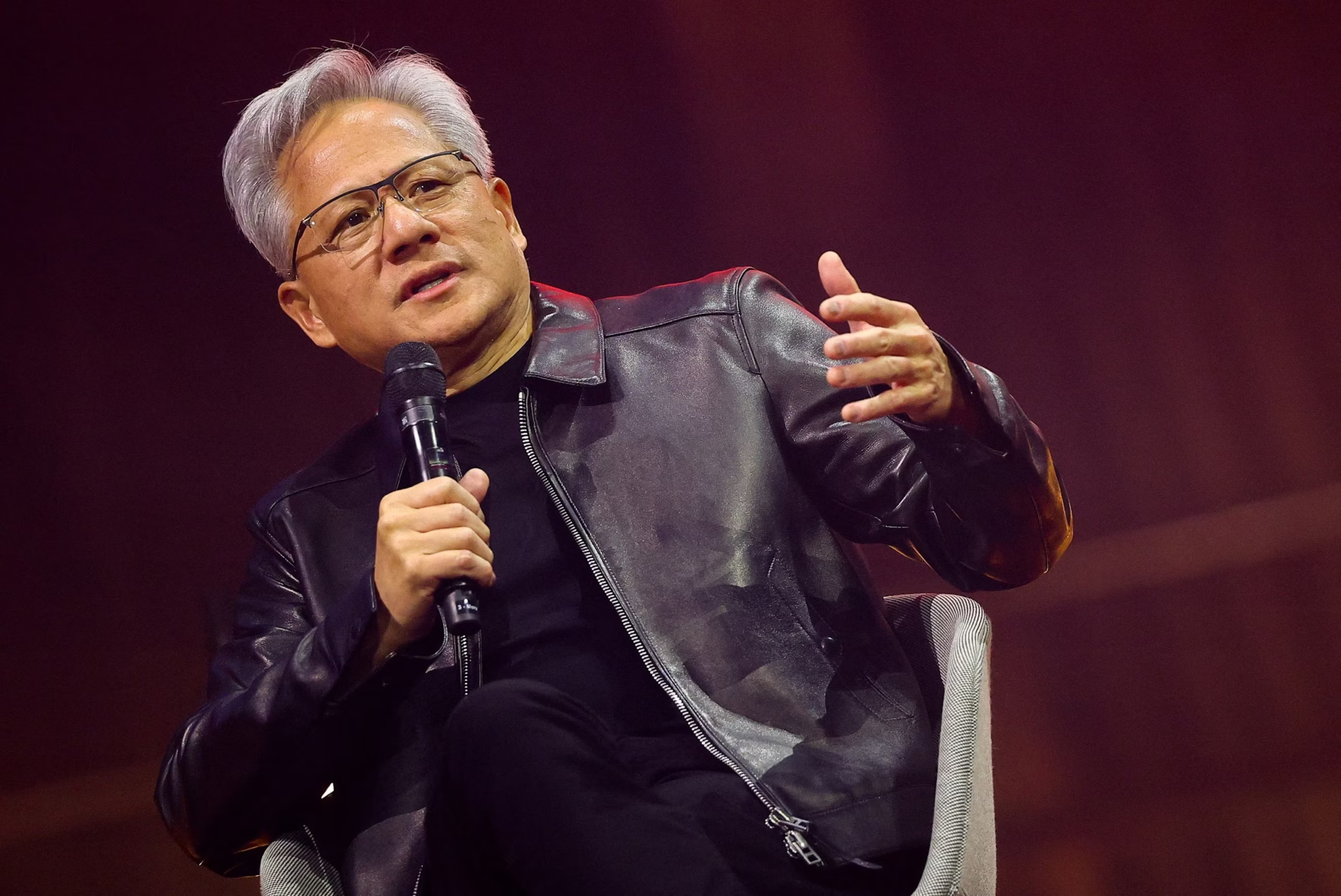
Jensen Huang has resigned as Nvidia’s chief executive, ending his 33-year tenure at the company he co-founded. Nvidia announced the departure on November 12, naming finance chief Colette Kress interim CEO and Harvey Jones its first board chair. Its regulatory filing provides the precise timing: directors accepted Huang’s resignation as president, CEO and board member on November 11, effective immediately.
The departure follows an investigation into reports of a foreign intelligence effort targeting Huang and a separate report alleging a relationship with an executive who reported to him. The leadership announcement does not give a specific reason for his resignation or publish findings on those matters.
For Nvidia, the immediate question is who can sustain the business while directors choose a permanent successor. The first scheduled financial checkpoint is November 17. But those results will cover a quarter that ended before Huang left. Readers will need to distinguish the performance Nvidia has already delivered from evidence about how it will operate without him.
Colette Kress takes charge, with the permanent job still open
Kress will retain her chief financial officer responsibilities while serving as interim CEO. Nvidia says its search for a permanent leader will consider candidates inside and outside the company. It has not announced a deadline or named a preferred successor. Nvidia’s transition statement.
She brings considerable familiarity with the business. Kress joined Nvidia as CFO in September 2013 and has appeared alongside Huang on its earnings calls. Her earlier career included finance positions at Texas Instruments, Microsoft and Cisco, according to Reuters’ profile.
That experience should help with the immediate demands of explaining performance, overseeing spending and communicating with investors. The larger task is coordinating the people making decisions about technology, customers and production while the leadership search proceeds.
Investors and analysts interviewed by Reuters have also discussed Ian Buck, who leads Nvidia’s hyperscale AI products and helped develop its CUDA software platform, as a potential successor. That is an assessment by outside observers, rather than an official shortlist. Reuters’ succession analysis.
The choice need not be reduced to a contest between finance and engineering. Whoever becomes the permanent CEO will need a credible division of responsibilities across both. During the interim period, Nvidia can make that arrangement clearer by explaining who holds authority over major product and investment decisions.
A new board chair inherits an unfinished investigation
Jones’s appointment changes Nvidia’s oversight structure. The company’s 2026 proxy statement described a board led by an independent lead director rather than a chairperson. That arrangement included meetings of independent directors without the CEO.
Jones is a longstanding participant in that system: the November filing says he has served on Nvidia’s board since 1993. His new position therefore gives an existing director a different leadership role. It does not, by itself, demonstrate that oversight problems have been identified or corrected.
The investigation remains a separate responsibility. On November 8, directors announced an inquiry into reports that Huang had been targeted by a foreign intelligence effort. They said they had no reason at that time to believe national security or Nvidia’s secrets had been compromised. Beijing has denied the allegation that the businesswoman involved was a spy, Reuters reported.
On November 10, independent directors retained former acting U.S. Attorney Joon H. Kim and Wachtell, Lipton, Rosen & Katz to conduct the investigation.
Huang had acknowledged marital infidelity in his November 8 message to employees. That admission did not identify the other person. The subsequent allegation of a relationship with a direct report originated in The New York Times, as described in CNN’s coverage. Resignation does not establish the truth of every allegation.
Growth Presto’s earlier examination of Nvidia’s board responsibilities set out the questions about conflicts of interest and company safeguards. Those questions survive a change of CEO. A useful board update would explain the review’s scope, whether it covers the reported workplace relationship, and what conclusions or corrective measures can be disclosed.
Nvidia’s business does not start again from zero
There is substantial operating momentum behind the transition. Nvidia reported revenue of $96.2 billion for the quarter ended July 26, up 106% from a year earlier. Data Center revenue reached $89 billion. Its August forecast for the following quarter was $108 billion in revenue, plus or minus 2%, with no China Data Center compute revenue assumed. Nvidia’s second-quarter results and outlook.
Those figures describe an established business with customers and products already generating sales. They provide a reason to question predictions that the founder’s departure must immediately derail demand. They cannot guarantee that execution will remain equally strong.
Jones said the board expects operations, customer commitments and the product roadmap to continue without interruption. That is the company’s stated expectation, which subsequent disclosures will need to substantiate. Nvidia’s announcement.
The distinction matters to customers as well as shareholders. A planned product launch, a delivery commitment and the financing behind a customer’s expansion are different obligations. Confidence in one does not automatically establish confidence in the others.
The practical questions are whether Nvidia retains the people needed to deliver its plans, meets customer commitments and explains any changes to major investments. None can be answered solely by the name at the top of the organization.
What the November 17 earnings report can—and cannot—show
Nvidia’s third quarter ended on October 25. Its results are scheduled for November 17, followed by an earnings call at 2 p.m. Pacific time, or 5 p.m. Eastern. The company’s earnings announcement establishes both dates.
That timing places an important limit on the numbers. Even an exceptional quarter would describe trading before the resignation. It would not demonstrate that the handover had succeeded. A disappointing quarter would likewise require an explanation rooted in the period being reported, rather than an automatic attribution to a later leadership change.
Different parts of the update will answer different questions:
| Evidence to examine | What it can clarify | What it cannot establish alone |
|---|---|---|
| Results for the quarter ended October 25 | Sales, profitability and cash generation before the departure | Whether the new leadership arrangement is working |
| The next-quarter outlook and answers on deliveries, staffing and investment | Management’s assessment of conditions through the transition | A guarantee that forecasts will be achieved |
| A separate update from independent directors | The investigation’s scope, findings and resulting safeguards | Whether customer demand or financial performance is strong |
The most useful management answers will connect assurances to specific operating responsibilities and commitments. If forecasts change, Nvidia should explain the underlying causes rather than leaving investors to infer them from the leadership upheaval.
The board also needs to communicate on its own timetable. An earnings call cannot substitute for an account of what investigators establish.
Huang’s departure has settled who will no longer lead Nvidia. The next test is whether the company can show how decisions will be made, how its commitments will be delivered and how the unresolved questions will be answered.