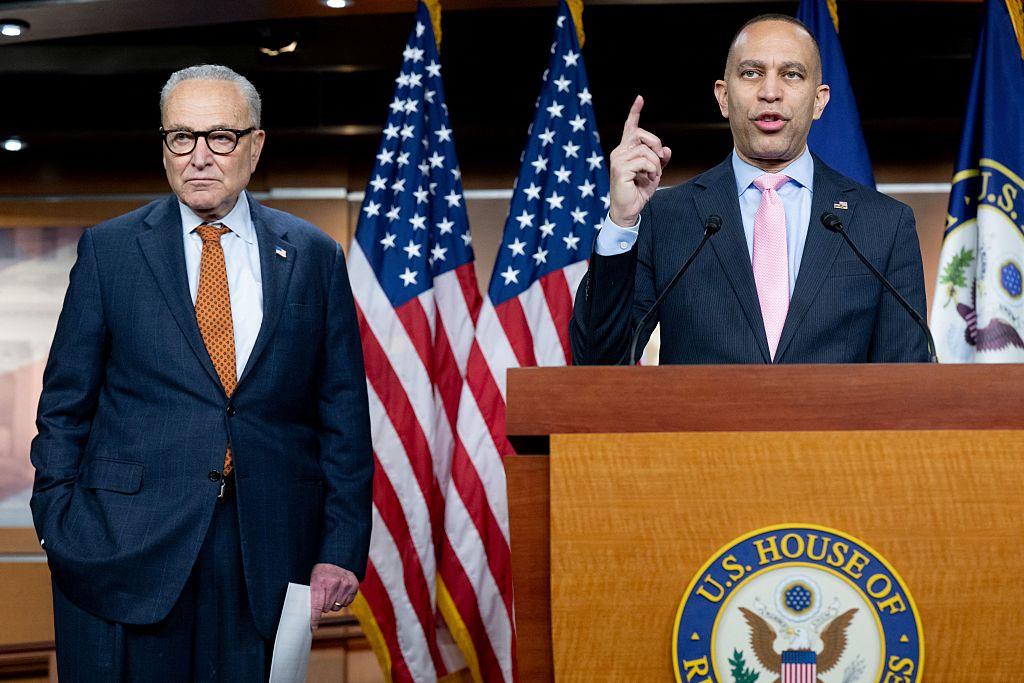
Abdul El-Sayed, Peggy Flanagan and incoming House progressives are demanding a different agenda. The first test is whether their leaders give those demands a route into legislation.
Peggy Flanagan had barely won her Senate race when she renewed her call for new Democratic leadership. At her first post-election news conference on November 4, the Minnesota senator-elect argued that the party’s incoming voices needed a different leader. She did not name a replacement. Minnesota Reformer
Chuck Schumer, meanwhile, predicted he would keep the job. Victory has sharpened the disagreement over what Democratic leadership should deliver. Roll Call
Democrats have won both chambers, but their new majorities begin with the next Congress on January 3, 2027. Reuters reports that Schumer is likely to retain his Senate leadership and Hakeem Jeffries is expected to become House speaker. Neither outcome is a completed vote. Reuters
The question facing them is whether keeping their positions will mean preserving the same boundaries around what Democrats are prepared to fight for.
Schumer faces named opponents, but no settled challenger
The dissent has identifiable names and different motivations.
Maine’s Troy Jackson has said he will support someone else. Illinois senator-elect Juliana Stratton’s campaign reaffirmed her opposition to Schumer on November 4. Kansas senator-elect Adam Hamilton has also rejected backing him, emphasizing fresh ideas and cooperation across party lines. Their objections cannot all be reduced to one progressive platform. Roll Call
Michigan’s Abdul El-Sayed has offered a possible alternative. In an MS NOW appearance earlier this fall, he supported Maryland Senator Chris Van Hollen for leader. After winning, El-Sayed said he wanted competing options and would assess them against his priorities: reducing money’s influence in politics, improving household finances and advancing Medicare for All. Roll Call
Van Hollen told The Washington Post on November 4 that he had no plans to seek the Senate leadership. The Washington Post
That leaves a gap between wanting another leader and organizing the votes to elect one. Roll Call reports that the caucus election will likely take place in early December, with senators-elect participating in a secret ballot. The available reporting does not establish majority opposition to Schumer. Roll Call
Even without defeating him, dissenters could seek commitments before voting. A promise to listen is difficult to enforce. An agreement to hold hearings, develop legislation or bring a proposal before the caucus gives members something concrete to judge.
Jeffries faces pressure over what reaches the House floor
Jeffries’ position is different. His expected elevation to speaker would itself be a major advance in power. The pressure from his left concerns what he intends to do with it.
New York representatives-elect Claire Valdez and Darializa Avila Chevalier have withheld support for his leadership unless priorities change, Gothamist reports. Avila Chevalier has identified Medicare for All, abolishing ICE, voting rights and universal childcare among her demands. Gothamist
Mayor Zohran Mamdani matters to this debate through the agenda and allies associated with his politics: affordability, taxing the wealthy and support for Palestinians. Gothamist describes that movement’s growing presence alongside Jeffries’ more centrist Brooklyn political base. That is evidence of competing approaches, without establishing that Mamdani is organizing a congressional leadership challenge. Gothamist
For incoming members, access to the legislative process may prove as consequential as the name on the speaker’s door. Will their proposals receive hearings and serious consideration? Will disagreements be debated publicly? Or will leadership invoke unity before members have had a meaningful say in the program?
Healthcare reveals the choices behind “affordability”
Healthcare offers the clearest comparison because the two approaches overlap before they diverge.
In a July 26 CNN interview published by his office, Jeffries backed reversing Medicaid cuts and extending Affordable Care Act tax credits. Those are identifiable policy commitments, and they deserve to be assessed on their merits. Jeffries’ published interview
El-Sayed’s healthcare platform also supports reversing Medicaid and ACA subsidy cuts. It additionally proposes extending Medicare to everyone, including dental, vision and hearing coverage, without premiums, copayments or deductibles. El-Sayed’s healthcare platform
The immediate repair work therefore need not divide them. The disagreement concerns what comes after those repairs.
In his August 16 NBC interview, as reported by Truthout, Jeffries described Medicare for All as “not legislation that I am currently cosponsoring or that I support.” He also declined to commit to bringing it to a vote. Truthout
That is a substantive boundary. Incoming advocates can reasonably ask whether their proposals will receive a legislative hearing even when the leader opposes them. They must also answer questions about financing, implementation and the transition for patients and providers. Serious consideration requires that scrutiny.
Growth Presto previously examined El-Sayed’s argument about household bills. His election moves that argument into a new setting: translating campaign commitments into legislation and assembling support for it.
ICE, Israel and political money widen the disagreement
The immigration dispute also needs precise language.
Truthout’s account of Jeffries’ August interview says he advocated substantial ICE reforms, including unmasking agents and body cameras, while declining to commit to a vote on abolition. That establishes a preference for reform; it does not establish an unconditional promise never to consider an abolition bill. Truthout
El-Sayed explicitly supports abolishing ICE and replacing its organizational structure. His platform retains border security and immigration enforcement, while calling for different safeguards and greater investment in immigration courts. The institutional disagreement is real and should be debated in those terms. El-Sayed’s platform
On Israel, El-Sayed advocates an arms embargo and enforcement of conditions on American military assistance. Gothamist identifies Jeffries’ longstanding support for Israel as another source of tension with the emerging left. El-Sayed’s foreign-policy commitments · Gothamist
Those differences should be tested through decisions about weapons, funding and oversight. Claims about donor influence require their own evidence; a contribution total alone cannot establish why a politician took a position.
El-Sayed’s proposals for public election funding and campaign spending limits offer a further question for leadership: which changes to the financing of politics will Democrats actually advance? El-Sayed’s campaign-finance proposals
A majority creates opportunities—and obligations
There is a strong argument against treating the election as an instruction to adopt every progressive proposal. Democrats won through a coalition.
Minnesota illustrates the complication. The Minnesota Reformer reported that Flanagan’s winning margin in unofficial results nearly matched that of moderate governor-elect Amy Klobuchar. The same electorate supported candidates offering different approaches. Neither faction can claim exclusive ownership of that result. Minnesota Reformer
The governing constraints are also real. Trump remains president. Under existing Senate rules, ending debate on most legislation ordinarily requires 60 votes. Holding a majority does not automatically supply the votes necessary to enact a programme. Reuters · US Senate
But leaders should distinguish obstacles to enactment from decisions about what their own party will attempt. A proposal can face a presidential veto and still deserve development, scrutiny and a public vote. Conversely, promising a vote without doing the work to build support can amount to little more than a gesture.
The useful test after January is whether leadership produces specific bills, hearing schedules and explanations of where agreements have broken down. Members seeking change should make their requests equally specific. Voters deserve to know which proposals lack support, who opposes them and what compromise is being offered.
Schumer and Jeffries may keep their positions. Their responsibility will be to show that newly elected Democrats can help shape the agenda—and that promises of change have consequences beyond the campaign.