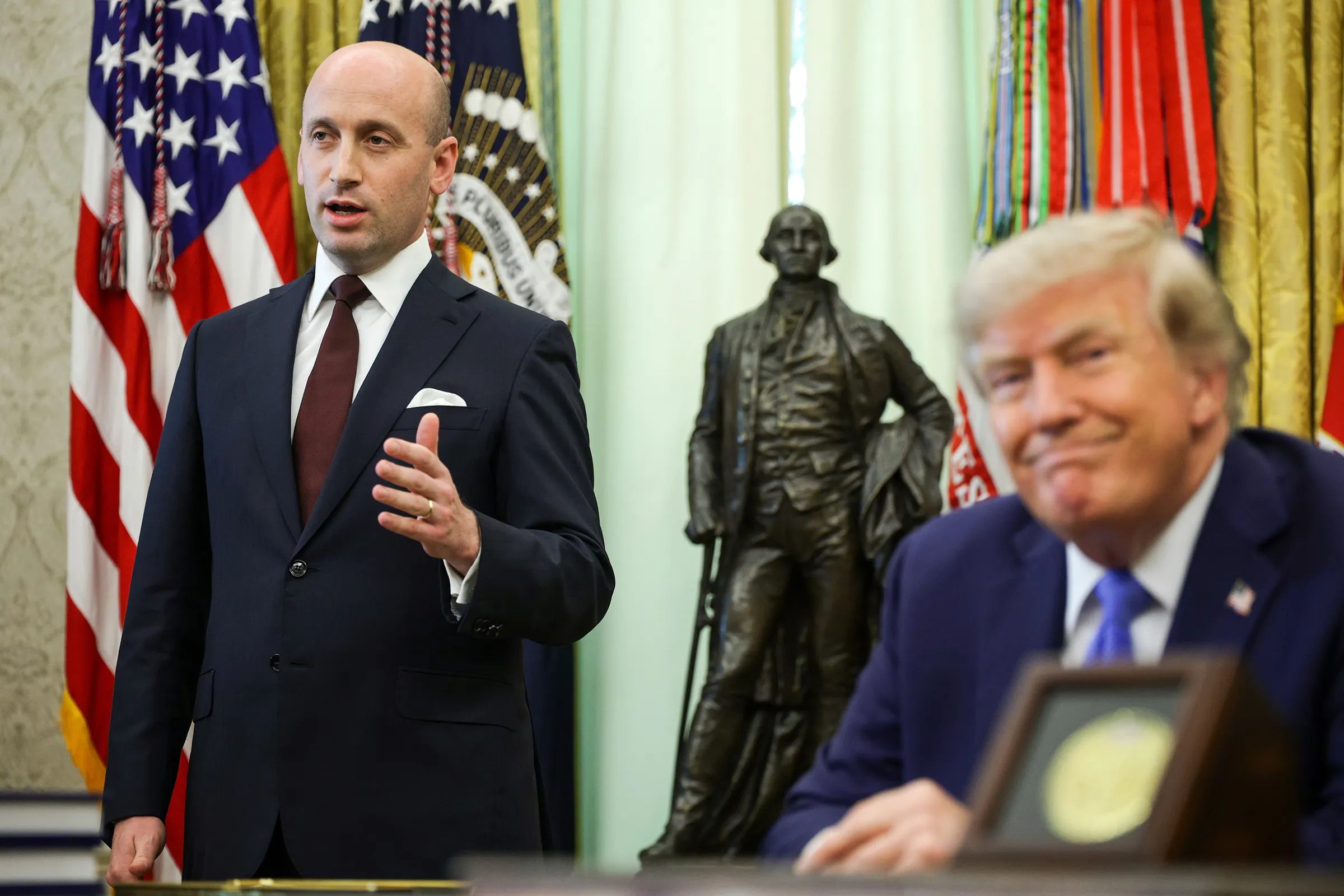
Three days after Republicans lost the House and Senate, Donald Trump chose Stephen Miller to replace Susie Wiles as White House chief of staff. The choice came after about six in ten midterm voters said the administration had gone too far on immigration enforcement, according to the Associated Press Voter Poll. Trump’s response was to promote the man who had pushed for at least 3,000 immigration arrests a day. AP on the appointment and voter poll · FactCheck.org on Miller’s arrest target
When Miller takes over on November 9, he’ll face a question of his own making. As the share of people arrested by U.S. Immigration and Customs Enforcement who had neither a U.S. criminal conviction nor a pending charge rose, did he reconsider what that daily target rewarded? House Democrats already intend to investigate his immigration policies. By promoting Miller, Trump has put the official who owes Congress an answer in charge of the White House staff that will help prepare it. Reuters on the handover and planned oversight
What an arrest target rewards
The administration offered two different accounts of whom ICE was looking for. Attorney General Pam Bondi said violent criminals were the priority. White House border adviser Tom Homan said anyone in the country illegally could face removal. An officer could follow either instruction and make an arrest that counted toward Miller’s 3,000. The daily total could tell the White House how busy its officers were. It could tell a community very little about whether it was safer. CBS News on the administration’s stated priorities
The arrest records show why that distinction matters. FactCheck.org examined ICE data obtained by the Deportation Data Project. During the first three months of Trump’s second term, 21.9% of people ICE arrested had neither a U.S. criminal conviction nor a pending criminal charge. In the three months ending in mid-October 2025, that share reached 40.5%. A person in that category could still face removal under immigration law. What changed was who accounted for the arrests. By the fall, roughly two out of every five people ICE arrested had no U.S. charge or conviction on record. FactCheck.org’s analysis of ICE arrest records
Those figures give Congress a precise question to put to Miller. When the share nearly doubled, did he consider revising the target? The records establish the change. Miller can explain what he knew about it and why he thought a raw arrest count was worth pursuing.
The story Miller wanted told about refugees
Years before Miller could set priorities for federal officers, he tried to influence how Americans saw the people those officers might encounter. When Pope Francis asked Catholic communities to welcome refugees, Miller urged a Breitbart editor to draw a parallel with The Camp of the Saints. Jean Raspail’s novel depicts arrivals from India as a threat to European civilization. It became a favorite among white nationalists. The subject of the proposed story was an offer of shelter. Miller supplied the image of an invasion. Research on the novel and Miller’s email
Former Breitbart editor Katie McHugh gave the correspondence to the Southern Poverty Law Center, which reported on it in 2019. ABC News also reported that Miller had sent McHugh a link from the white nationalist website VDARE during a discussion about people displaced by a hurricane. The White House dismissed the SPLC’s reporting and attacked the organization’s credibility. The reason to revisit the correspondence now is the editorial choice Miller made himself. He wanted readers to understand actual refugees through a racist work of fiction. Trump has since entrusted him with decisions that affect actual families. ABC News on the emails and the White House response
The question that follows Miller into the chief of staff’s office
There is a case for the appointment on Trump’s terms. Miller knows the federal government and has worked for Trump since his first presidential campaign. With Democrats taking control of Congress in January, a president expecting few legislative victories may value an aide who knows what he can accomplish through executive action. Trump praised Miller’s political judgment and management skills when he announced the choice. AP on Trump’s reasoning and Miller’s experience
The trouble with that calculation is what voters wanted Congress to do. About seven in ten midterm voters told AP that Congress had done too little to check the president. In the same survey, everyday costs weighed heavily on voters, and roughly two-thirds said Trump’s policies had made the economy worse. Immigration was one part of a broader defeat. Yet it is one issue on which voters gave a fairly clear verdict and Trump had an immediate opportunity to respond. AP’s national midterm voter poll
Rep. Robert Garcia of California, the top Democrat on the House Oversight Committee, has already said Democrats intend to investigate Miller’s immigration policies. A committee could start by asking for the instructions ICE field offices received and the reports officials sent back as the mix of arrests changed. Those records would give the public a way to judge the policy in Miller’s own terms. What did the White House count, and what did it do with the answer? Reuters on Garcia’s plans
Trump could have asked Miller those questions before handing him the job. By promoting him, the president has offered a verdict of his own. Whatever those arrest numbers meant for the people behind them, the official who demanded them earned a promotion.