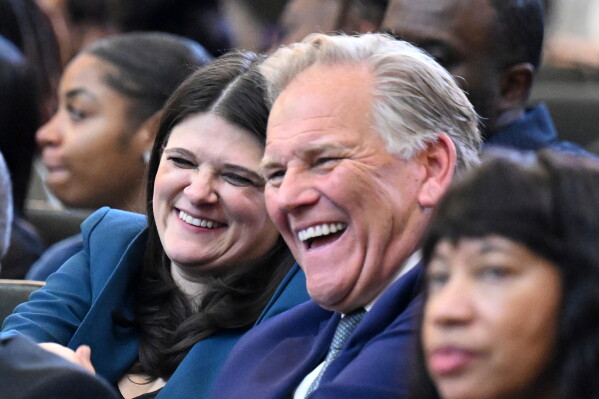
Haley Stevens endorsed Republican Mike Rogers on 1 November, two days before Michigan’s Senate election, abandoning Democratic nominee Abdul El-Sayed after losing to him in the primary. Bridge Michigan reported the endorsement and her appearance alongside Rogers in Detroit.
The problem is not that Stevens owes El-Sayed personal affection, or that Democrats must agree on everything. It is that she spent her own campaign explaining why Michigan needed someone who would resist Donald Trump—and has now endorsed a candidate who explicitly promised to help him.
That contradiction deserves an answer. A deteriorating relationship with El-Sayed does not, by itself, explain why Rogers became the better choice for the public.
Stevens set the standard herself
This is not an argument invented by her critics after the endorsement.
In her 22 April 2025 campaign announcement, Stevens made opposition to Trump central to her Senate bid. She warned about his tariffs, their risks to Michigan jobs and the uncertainty facing families. Her stated purpose was to lower costs and stand up to his administration.
She was making essentially the same case four days before switching sides.
On CNN’s The Source on 28 October, Stevens confirmed that she would vote for El-Sayed and encouraged her primary supporters to do so. Discussing Trump’s agenda, she said, “We need the person who’s not going to rubber stamp this agenda in that seat.”
Rogers’s own campaign launch statement promised that he would be “an ally for President Trump.”
Those are competing purposes for the same Senate seat. Stevens is entitled to change her assessment of a candidate. But the consequences she warned about do not disappear when the Democratic nominee disappoints her.
The advertisement dispute needs its full chronology
Stevens’s concerns should be described accurately, not dismissed as an excuse.
In the CNN interview, she objected both to an outside advertisement about Israel and grocery prices and to a separate campaign advertisement featuring Tucker Carlson. She presented those objections as concerns about hateful rhetoric and whether people felt welcome and safe in the Democratic coalition.
The outside advertisement came from Rebellion PAC, not El-Sayed’s campaign. On Saturday, 31 October, El-Sayed expressly rejected its message: “I do not agree with the contents of that ad,” Spectrum News reported. He also dismissed the controversy’s relevance to voters—a response critics can reasonably find insufficiently sensitive.
Stevens welcomed his rejection that night.
That sequence matters. It does not establish that every concern Stevens raised had been resolved. It does mean the endorsement cannot fairly be explained as a response to a continuing refusal to reject the outside advertisement.
There is another distinction worth preserving. In her endorsement video, Stevens linked her decision to being told she was no longer welcome in El-Sayed’s campaign, the Guardian reported. But Representative Debbie Dingell told the Associated Press that she had asked Stevens not to attend the planned joint church appearance because the dispute had become distracting.
Dingell’s account does not establish that El-Sayed had no involvement in the wider rupture. It does complicate a simple story in which one candidate’s rejection explains everything that followed.
Even accepting that Stevens felt unwelcome, declining to campaign with El-Sayed and endorsing Rogers were separate choices.
Criticism of Israel is not a substitute for examining the evidence
The controversy also requires care about what El-Sayed actually argued.
PolitiFact’s 30 October examination found that his criticism of military aid to Israel formed part of a broader argument about spending priorities, military expenditure and taxation. It did not support describing Israel as his sole explanation for inadequate domestic services.
The same examination supplied an important limitation: ending aid would not automatically redirect that money into schools or healthcare. Congress would still have to decide how to use any savings.
Both points belong in an honest account. El-Sayed’s budget arguments deserve scrutiny. So does a description of those arguments that strips away their wider context.
Criticizing an Israeli government’s conduct, or opposing American military assistance, is not inherently hostility toward Jewish people. Nor does that principle excuse antisemitic language when it occurs. The responsible test is the particular statement and its meaning—not an assumption about a speaker’s religion or a critic’s motives.
El-Sayed has also publicly committed to protecting Jewish communities, according to MLive’s reporting. That commitment does not place him beyond criticism. It belongs in the record alongside the criticism.
An endorsement chooses a governing agenda
Stevens did offer a positive policy point on Sunday: she praised Rogers’s prospective support for Black-owned businesses, according to Bridge Michigan.
That should be acknowledged. It still leaves the larger trade-off unexplained.
Healthcare provides a concrete example. El-Sayed’s platform calls for universal Medicare coverage without premiums, copayments or deductibles, expanded prescription-drug negotiation and opposition to cuts in Medicaid and Affordable Care Act subsidies.
Rogers’s published healthcare plan instead emphasizes price disclosure, expanding access to Trump Rx, faster approval of lower-cost generics and penalties for insurers with excessive denials or delays.
These are campaign proposals, not guaranteed outcomes. El-Sayed would need legislation and a workable financing and implementation strategy. Rogers’s proposals also deserve scrutiny of their likely effects. But voters are choosing between materially different approaches—not merely deciding which candidate handled a dispute more graciously.
Supporting El-Sayed makes sense on those substantive grounds: broader healthcare coverage and a Senate voice prepared to challenge Trump rather than serve as his advertised ally.
That support need not be unconditional. Voters can demand better answers from El-Sayed about spending, rhetoric and coalition-building while still concluding that electing Rogers would move the country in the wrong direction.
Disagreement does not settle the choice
No politician owes a party automatic loyalty. Crossing party lines is justified in some circumstances, including serious objections to a nominee’s conduct or commitments.
But crossing that line creates an obligation to explain the alternative. Which outcomes now make Rogers preferable? Why should his promised alliance with Trump matter less than the dangers Stevens herself identified? What changed in her assessment of those stakes between Wednesday and Sunday?
Those questions are more demanding than an insult. They ask Stevens to explain why she chose against her own publicly stated priorities.
The strongest case for El-Sayed is not that he must be right about everything. It is that voters can hold him accountable without handing the seat to a candidate committed to strengthening the administration they want checked.
Stevens once argued that Michigan needed someone who would resist Trump’s agenda. Her endorsement changed. She still owes the public an explanation of why that argument should.