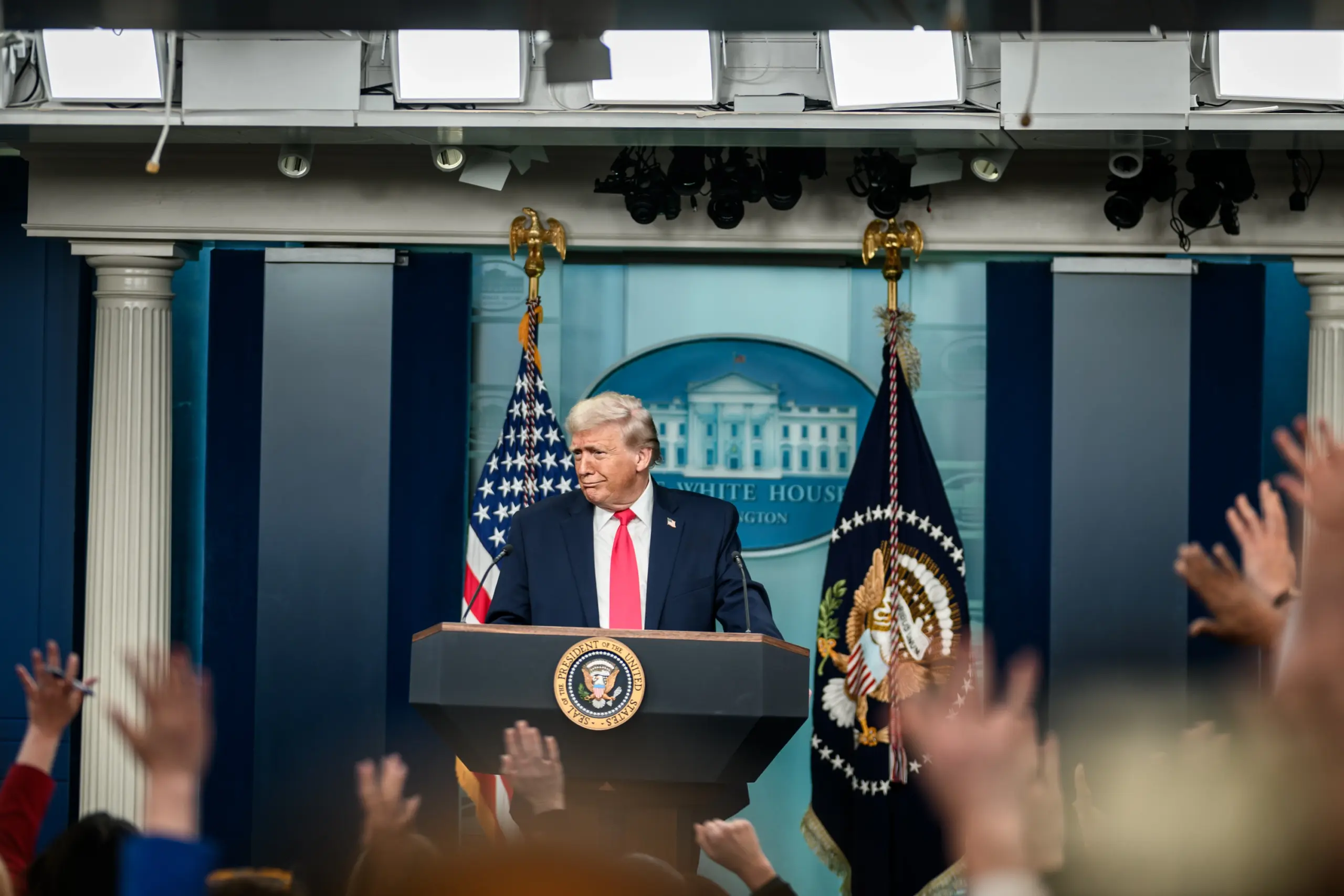
Donald Trump’s response to the nationwide FAA ground stop puts his approach to accountability in plain view. As passengers dealt with disrupted journeys, the president accused Joe Biden’s administration of making an “old and broken system worse than when they began.” His comments came on Sunday, November 15, two days after the disruption began, according to the Associated Press.
Trump is entitled to scrutinize what he inherited. Americans are equally entitled to scrutinize what he is doing with it.
He campaigned on making daily life more affordable. His administration now wants Congress to fund a much larger air traffic control overhaul. Both commitments deserve the same test: what will the public receive, when will it arrive, and who answers when the promises fall short?
Blaming Biden does not answer any of those questions.
The FAA is still investigating. Trump has already assigned political blame.
The FAA’s November 15 explanation describes older network equipment becoming unstable after excessive data traffic disrupted communications and radar feeds. Investigators identified two potential sources in Texas and Arkansas. Contractor L3Harris had been working at the Arkansas site, including installing a router.
The agency said the root cause remained under investigation.
That matters. A technical investigation can establish which equipment failed, what procedures were followed and whether safeguards were adequate. An accusation against a former president cannot substitute for those findings.
The FAA also says its broader modernization effort did not cause the disruption and that upgraded towers remained operational. Those facts deserve space in any serious criticism. Grounding departures was a protective response; the agency says the aircraft landed safely.
There is also a documented history of neglect. A September 2024 Government Accountability Office report described an FAA assessment that classified 51 of its 138 air traffic control systems as unsustainable and another 54 as potentially unsustainable. These problems plainly predate Trump’s current term.
But inherited weaknesses increase the importance of competent management. The administration running the system must explain how it assessed those risks, supervised maintenance and prepared to contain failures.
Flights resuming after the ground stop answered the immediate question of whether departures could restart. It did not settle who was responsible for the breakdown.
The $50 billion demand comes with an existing oversight problem
Transportation Secretary Sean Duffy made the $50 billion call. At the November 13 briefing, he distinguished the president’s request for $30 billion from his own preference for $50 billion.
The figures circulating in this debate describe different things:
| Amount | What it represents |
|---|---|
| $12.5 billion | Funding Congress approved in 2025, described by Duffy as a down payment. |
| $30 billion | The amount Duffy said Trump had requested. |
| $50 billion | The amount Duffy called for at the November 13 briefing. |
Sources: AP’s funding account and the briefing transcript. These figures should not be added together or treated as an approved $50 billion appropriation.
A national aviation system can require substantial investment. The amount alone does not establish waste. The stronger objection is that the administration must demonstrate how the money will be managed.
A GAO report published September 14, 2026, had already identified serious weaknesses in the new modernization program. It found no reliable, comprehensive estimate covering the program’s full lifetime and no integrated master schedule for its first phase. Instead, the FAA had 11,389 individual project schedules that were not integrated.
The Transportation Department disputed aspects of that assessment, saying teams were updating program estimates and developing scheduling capabilities. GAO maintained that the work did not meet its standards. Its recommendations remained listed as open when checked on November 15.
The watchdog also acknowledged progress in replacing old communications infrastructure. Its findings do not establish the cause of Friday’s disruption. They establish a separate, concrete reason for Congress to demand stronger financial and operational oversight.
Before approving a larger package, lawmakers should require an updated cost breakdown, a coordinated delivery schedule and clear reporting on contractor performance. The public should be able to see what existing funding has delivered and what each proposed expansion would buy.
Urgency makes that discipline more necessary.
Americans’ affordability concerns are measurable
Trump’s promises on household costs were explicit. During a September 2024 grocery-store visit, he told shoppers he would bring prices down, AP reported at the time. The 2024 Republican platform also committed to reducing health care costs and everyday expenses.
Those commitments gave voters a reasonable basis for expecting tangible improvements.
An AP-NORC survey conducted October 8–12, 2026 found that 84% of voters considered the cost of living one of the most important issues in their election decision. Health care was a leading issue for 69%. The same poll found 79% disapproved of Trump’s handling of living costs.
A separate KFF survey conducted September 16–21 found 60% of registered voters worried about affording health care and 52% worried about food and groceries.
These surveys preceded the ground stop. They measure existing priorities and concerns, not public reaction to this particular outage.
They nevertheless explain why an argument about presidential responsibility extends beyond the airport. People have bills to pay, prescriptions to collect and food to buy. A government asking them to trust its next major promise should expect questions about the promises already made.
Responsibility cannot depend on whether the news is good
Presidents do not personally control every grocery price or every piece of aviation equipment. As AP’s reporting on grocery prices explains, food costs reflect forces that extend beyond the White House. Replacing a national communications network also takes time. Honest leadership should explain those limits consistently.
Trump cannot fairly present himself as the decisive force behind improvements while treating failures as his predecessor’s permanent responsibility.
The FAA investigation should establish what happened. Congress should examine the funding request against documented needs and measurable delivery commitments. Household affordability should be judged by what people can actually afford.
For passengers, patients and families buying groceries, the useful measure of government is whether daily life becomes safer, more reliable and more affordable.
Biden is no longer president. Trump is. The responsibility comes with the job.