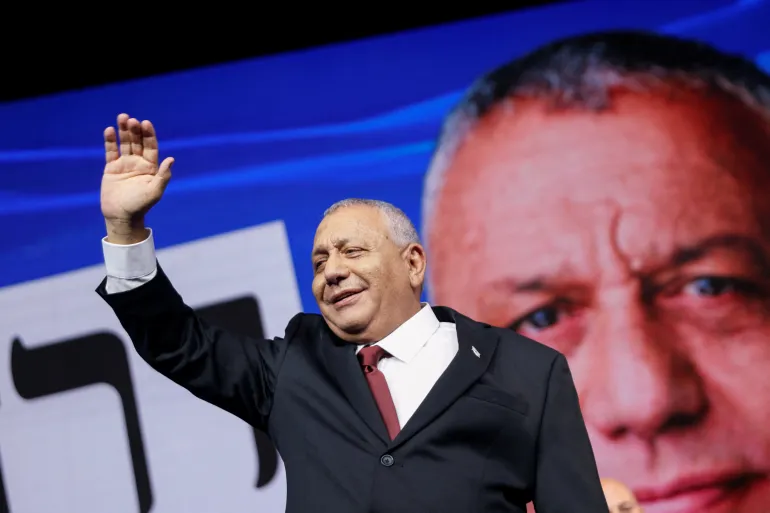
Israel’s President Isaac Herzog has chosen Gadi Eisenkot to try to form the country’s next government, giving Benjamin Netanyahu’s rival the first opportunity to turn the election result into a change of leadership.
Herzog announced his decision on November 7, with the formal handover of the mandate scheduled for November 8 at 5 p.m. Israeli time. Eisenkot will then have 28 days to assemble a government, with a possible extension of up to 14 days. Herzog’s announcement and timetable
The decision opens a route to replacing Netanyahu, although a new government still has to win parliament’s confidence. For Palestinians and international supporters of a two-state solution, another question follows: how much would Eisenkot actually change?
His stated policies suggest potential differences on settler violence and some settlement expansion, alongside substantial continuity on Palestinian sovereignty and Gaza. The negotiations will test which of those positions can become government policy.
Why Herzog chose Eisenkot
After consulting the parties elected to Israel’s parliament, the Knesset, Herzog said factions representing 67 lawmakers had recommended Eisenkot, compared with 46 for Netanyahu.
Those recommendations gave Eisenkot an advantage, but Herzog acknowledged that disagreements between and within the political blocs left the path to a government uncertain. His task is to identify someone capable of assembling a government, rather than automatically appointing the leader of the largest party. Herzog’s statement after the consultations
The election produced three broad groups:
| Parliamentary grouping | Seats |
|---|---|
| Jewish opposition parties aligned against Netanyahu | 48 |
| Netanyahu’s outgoing governing bloc | 53 |
| Arab-led parties | 19 |
| Total | 120 |
These are the post-election bloc totals reported by Reuters. They describe the balance of seats, rather than an agreed coalition. Reuters’ account of the election arithmetic
The distinction explains the difficulty facing Eisenkot. Adding the 48 opposition seats to the Arab-led parties’ 19 produces 67. Turning those recommendations into dependable parliamentary support requires agreements among parties with different priorities and objections to working together.
There is also a procedural detail that matters. A new government needs more votes in favor than against in its initial confidence vote; it does not necessarily need 61 affirmative votes. Outside support or abstentions can therefore allow a minority government to take office. Israel Democracy Institute’s explanation of the confidence vote
The partners Eisenkot would need
One option is cooperation with Arab-led parties, including support from outside the cabinet. The Associated Press reports that Eisenkot has indicated conditional willingness to work with them, including requiring them to recognize Hamas as a terrorist group that must be destroyed. Some allies oppose a government dependent on Arab-party support. Those positions leave a substantial obstacle between the recommendation stage and a confidence vote. AP on the possible alliances
Another route involves the ultra-Orthodox parties. United Torah Judaism holds seven seats and Shas six. Together with the 48-seat opposition bloc, that would amount to 61 seats if all joined.
But military service remains a major disagreement. Eisenkot has reaffirmed mandatory military, national or civilian service as a condition for partners. Shas has also rejected reports that it could join an Eisenkot government. Neither party can be counted as secured support. Reporting on the ultra-Orthodox negotiations
Netanyahu, meanwhile, has called for a national unity government. Eisenkot’s Yashar party has said Likud could join an Eisenkot-led administration if it breaks with extremist allies and accepts his principles. That leaves the central dispute over leadership unresolved. The competing unity proposals
For readers abroad, these negotiations matter because the parties providing parliamentary support will help determine what a new prime minister can deliver.
Eisenkot’s Palestinian position falls short of two states
Eisenkot, a former military chief, has presented himself as an alternative to Netanyahu. His position on Palestinian self-government nevertheless leaves Israel with overriding security control.
In a published interview with The Times of Israel, he described a future arrangement involving autonomy or a “state-minus”, without a Palestinian army. He also said the Palestinian Authority should be allowed to govern the Palestinian population in the West Bank. Eisenkot’s published interview
For anyone hoping this election will revive a sovereign Palestinian state alongside Israel, those limits are significant. Reuters’ pre-election comparison found that both Eisenkot and Netanyahu oppose an independent Palestinian state and favor ultimate Israeli security control between the Jordan River and the Mediterranean Sea. Reuters’ comparison of their Palestinian policies
Replacing Netanyahu could alter the government’s priorities and partners. A commitment to Palestinian sovereignty would require a further policy change.
Settler violence is an area where promises can be tested
Eisenkot has pledged to prevent attacks on Palestinian homes and villages. He has also proposed removing Bezalel Smotrich’s ministerial authority within the Defense Ministry and changing the command arrangements responsible for security in the West Bank.
On settlements, his position distinguishes between those authorized by Israel and unauthorized outposts. He has promised to evacuate illegal outposts in Areas A and B, where the Palestinian Authority exercises forms of control, while retaining Israeli-approved settlements in Area C for further examination. His commitments on West Bank governance and settlements
That distinction concerns Israel’s own approval system. International law sets a different standard. In its July 2024 advisory opinion, the International Court of Justice concluded that Israel’s continued presence in the occupied Palestinian territory was unlawful and that Israel was obliged to halt new settlement activity and evacuate settlers. The court’s summary of its advisory opinion
Stronger protection against attacks could make an immediate difference to Palestinian families. It would still leave the wider questions of occupation, land and self-determination unresolved.
Gaza will test the limits of any change
On Gaza, Reuters reported before the election that both Netanyahu and Eisenkot opposed an Israeli troop withdrawal until Hamas disarms and were prepared to resume fighting to achieve that objective. Eisenkot said he would seek to replace Hamas’s administration within 18 months of taking office through a US-backed arrangement or military force. Their stated positions on Gaza
Those positions do not assure that a change of prime minister would end Palestinians’ suffering or remove the risk of further war.
The record a successor would inherit includes the September 2025 finding by the UN Independent International Commission of Inquiry that Israel had committed genocide in Gaza. Israel rejected the commission’s conclusions and denied genocidal intent. The finding was issued by an independent UN-appointed investigative body. UN reporting on the findings and Israel’s response
A meaningful assessment of any new government should therefore examine concrete decisions: protecting civilians, allowing humanitarian assistance, enabling reconstruction, preventing forced displacement and pursuing accountability. A leadership change alone does not answer those questions.
What happens next
The next scheduled step is the formal transfer of the mandate on November 8. Coalition agreements and a successful confidence vote would follow if Eisenkot can secure sufficient support.
If his attempt fails, further government-formation procedures remain available, potentially involving another candidate. Another election becomes possible if those efforts also fail. The government-formation process
For Netanyahu, Herzog’s decision creates a serious challenge to his continued leadership. For Palestinians, the more consequential developments will be the terms of any coalition agreement, who controls the ministries affecting their lives, and whether promises of restraint become enforceable policy.
Eisenkot has an opportunity to assemble a government. The negotiations will reveal whether that government offers Palestinians greater safety and political rights—and how far it remains from a negotiated two-state peace.