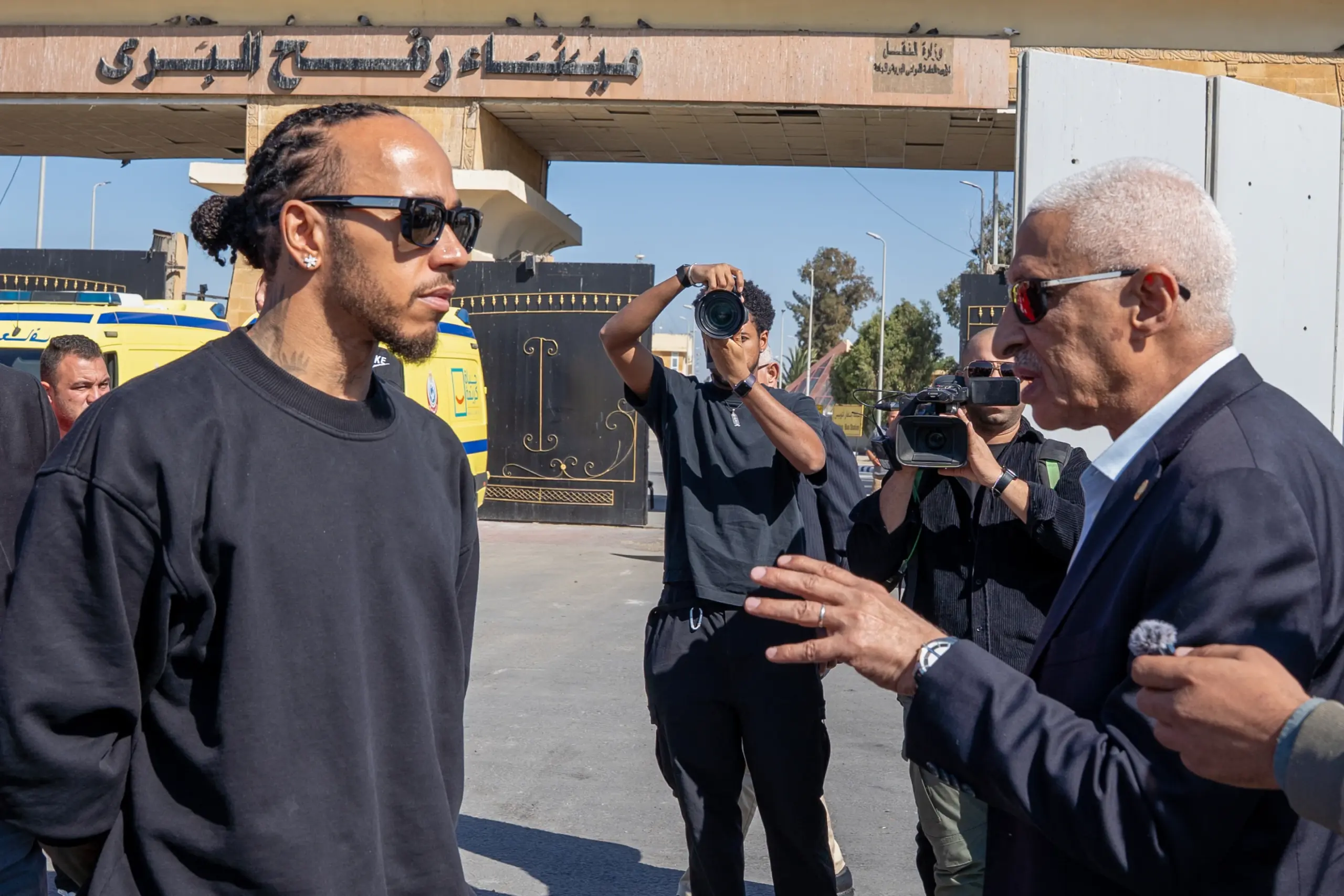
Lewis Hamilton visited Egypt’s Rafah crossing and aid warehouses on November 10, bringing attention to the effort to help Palestinians in Gaza. His visit came as families inside the territory struggled with flooded shelters—and as the United Nations warned that essential supplies and equipment were still not reaching them in sufficient quantities.
The seven-time Formula One champion toured the Egyptian Red Crescent’s facilities in El Arish and received briefings on preparing and coordinating relief, according to Reuters’ account of the visit. The reporting places him on the Egyptian side of the border; it does not establish that he entered Gaza.
For people who admire Hamilton, his willingness to show up deserves recognition. The visit also opens a more demanding conversation: what must happen between preparing assistance outside Gaza and giving a family inside it somewhere safe to sleep?
Inside Gaza, families are trying to save their bedding
On November 7, Reuters spoke to Olfat Magdoub as she tried to sweep water away from her tent in Gaza City. She described mattresses soaked by the rain and having to sleep on the ground.
“This is only the first day and we’re already overwhelmed,” she told the news agency. Reuters’ reporting from the flooded camps describes residents reinforcing tents with sand and moving children out of the water.
Her account gives the weather reports their human meaning. Bedding is among the few things a family can use to make a temporary shelter habitable. When it is soaked, waiting for the next delivery means trying to get through another night without it.
The danger extends beyond discomfort. UNICEF reported on November 10 that three children and their mother had died when a dune collapsed onto their tent in Deir al-Balah after heavy rainfall. The agency estimated that 950,000 displaced people were living in areas exposed to flooding.
These deaths make safe accommodation an immediate question of survival. Families should not have to choose between a tent exposed to storms and a damaged building that could collapse.
Supplies outside Gaza cannot protect a family inside it
The UN Office for the Coordination of Humanitarian Affairs, OCHA, reported that more than 150,000 tents were outside Gaza ready for dispatch. Meanwhile, humanitarian stocks of tents, tarpaulins, blankets and clothes inside the territory were virtually exhausted.
Its November 8 situation report, published November 9, identified both Israeli restrictions on supplies and equipment and funding shortfalls as constraints on winter preparations. It called for additional Israeli approvals and funding to bring in essential materials and machinery.
That helps explain why images of stocked warehouses cannot, by themselves, establish whether people are receiving adequate help. There are three separate questions: Is assistance available? Can it enter and reach its intended recipients? Does it provide enough protection once it arrives?
Hamilton’s tour drew attention to the preparation stage. Following the story through to Palestinian families requires answers to all three.
Aid is entering, and some measures have been taken. In a statement reported by Reuters on November 7, COGAT, the Israeli military agency coordinating humanitarian affairs, said it had increased efforts to improve sanitation ahead of the rain. It cited four additional vacuum trucks entering that week through the International Committee of the Red Cross, following eight during the previous month. COGAT’s account, reported by Reuters.
Those deliveries matter. They also leave the question of adequacy open: equipment entering Gaza is a measure of activity; families protected from flooding is the outcome that activity must achieve.
A drainage repair shows what is at stake
On the same day as Hamilton’s visit, UNICEF raised a specific obstacle. Its spokesperson, James Elder said Israel had rejected a $3 million proposal to repair the Sheikh Radwan stormwater basin in Gaza City.
According to Reuters’ November 10 report, Elder said the agency had spent a year working with Israeli authorities and the US-backed Board of Peace on the project. He said COGAT had cited security grounds for the rejection. COGAT had not immediately responded to Reuters’ request for comment.
UNICEF warned that the basin, contaminated with sewage, could overflow into surrounding streets and tents. Its separate statement said only two of the basin’s six pumps were functioning and urged Israel to allow equipment needed for water and sanitation repairs.
The example matters because replacing a tent cannot resolve the danger from a failing drainage system beside it. Effective winter assistance also requires pumps, spare parts and repairs that reduce the likelihood of shelters flooding again.
This is a concrete decision to follow after the cameras leave Rafah: whether the repair is approved, the necessary equipment arrives and the basin is made safer.
Hunger adds another pressure—and funding matters too
The food emergency has its own constraints. On October 19, the World Food Programme announced that funding shortages had forced it to reduce the number of people receiving food and cash assistance in Gaza from 1.6 million in September to 1.1 million in October.
The agency also said it had halved food rations and reduced daily hot meals from 250,000 to 150,000. Those are the measures in its October funding announcement, rather than a new count of November distributions.
That distinction matters for accountability. Israeli authorities control consequential decisions about humanitarian access. Donor governments also make decisions that determine whether agencies can sustain assistance. Removing an entry restriction does not replace lost funding; additional funding does not remove an entry restriction.
The storm created further disruption. OCHA reported temporary reductions at community kitchens and missed meal deliveries on November 7, while noting that the affected production and deliveries returned to normal on November 8. OCHA’s account of the interruptions and recovery.
Acknowledging that recovery gives aid workers their due. It also shows how quickly bad weather can interrupt services on which displaced families depend.
What Hamilton’s attention can help sustain
It is natural to wonder how Hamilton would react if he went beyond the border and met families living in these conditions. We cannot write that reaction for him. Palestinian residents have already described what they are enduring, and their accounts deserve attention in their own right.
His visit can introduce those accounts to readers who first encounter the story through Formula One. The useful next step is to keep following what happens to the people receiving aid: whether a replacement shelter stays dry, whether meals remain available and whether damaged infrastructure is repaired before another storm.
Hamilton deserves credit for taking an interest and visiting the workers preparing assistance. The lasting value of that attention will depend on whether it helps sustain scrutiny of the decisions governing Palestinian lives.
For Olfat Magdoub and families facing the same conditions, the urgent question remains the one her experience poses: where can they sleep when the rain comes again?