Commentary
Barack Obama made the attack on Amy Acton’s childhood a question of political standards. Donald Trump has defended it as an opportunity worth taking.
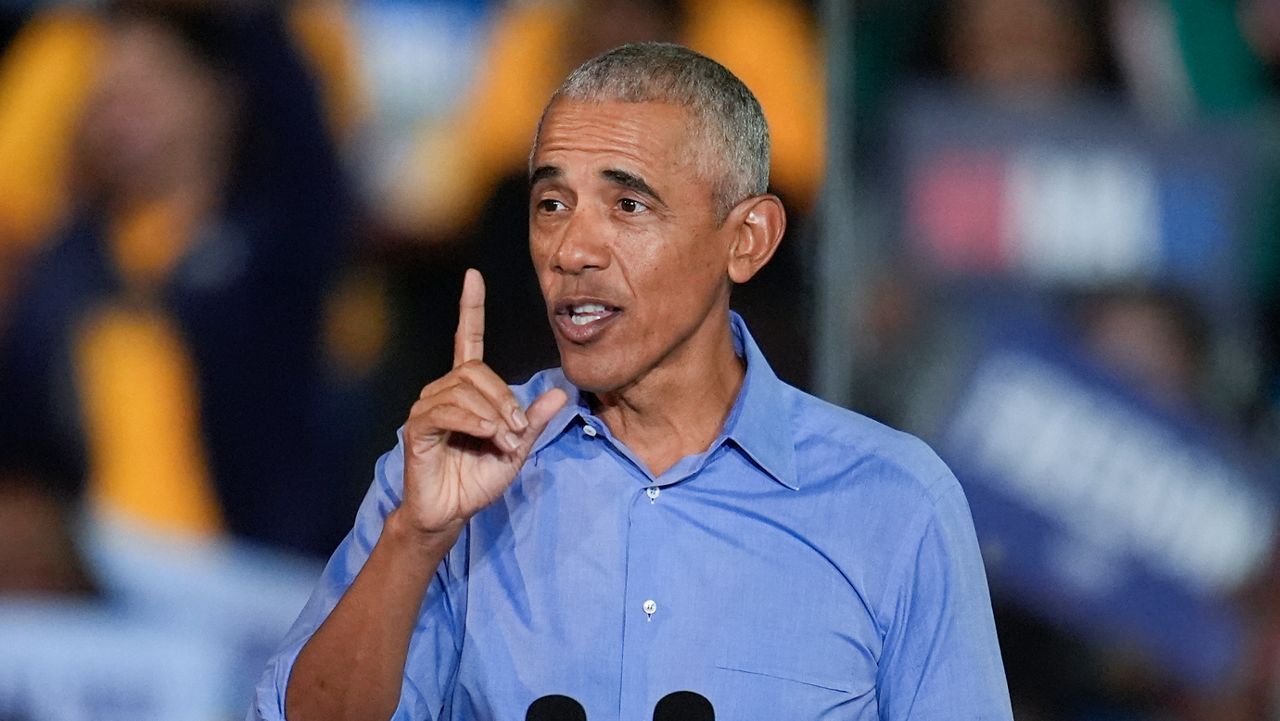
Campaigning in Cleveland on October 24, 2026, Obama condemned Vivek Ramaswamy’s advertisement featuring the estranged mother of his Democratic opponent for Ohio governor. “There’s a decency we should expect out of our public officials,” he said, according to The Associated Press.
Trump had already urged Ramaswamy to keep running the ad. His October 22 Truth Social post described using it as “hitting pay dirt.”
The contrast is sharp, but treating this as another clash between two presidents misses an important part of the story. Republican Governor Mike DeWine also wanted the ad removed—and maintained his endorsement of Ramaswamy. As Signal Statewide reported, his objection to the tactic did not amount to support for Acton.
That distinction matters. Rejecting this advertisement does not require agreeing with Acton’s policies. It requires deciding whether a campaign’s treatment of an opponent should have limits, including when crossing them might help your own side.
Obama made decency part of the campaign
Obama appeared alongside Acton and Democratic Senate candidate Sherrod Brown at Cleveland’s Public Auditorium. His broader argument was that voters could constrain Trump’s agenda through congressional and state elections, Ideastream Public Media reported.
Acton addressed the advertisement herself. She accused her opponent of deliberately exploiting her childhood and connected those experiences to her decision to become a doctor and pursue public service, according to the same report.
Obama’s intervention was plainly partisan: he was campaigning for Democrats. That does not invalidate the standard he invoked. It does mean the standard should survive a change of party labels. A Democratic campaign using a Republican opponent’s estranged parent in comparable circumstances would owe voters the same evidence and context.
Nor does defending Acton from this attack make her public record immune from scrutiny. Her decisions as Ohio’s health director, her policy proposals and her readiness to govern remain legitimate subjects of examination. The question is what this particular advertisement establishes about them.
Trump’s defence turns family status into authority
Trump’s written defence did more than praise the advertisement’s effectiveness. He argued that such criticism from a mother would ordinarily make her daughter unsuitable for office. He also attacked DeWine for urging its removal, portraying that objection as disloyalty to Republicans.
The post supplies a clear account of Trump’s position. It supplies no documentary evidence disproving Acton’s childhood account.
On October 24, Trump again defended the advertisement, presenting the mother’s criticism as an especially strong reference against her daughter, AP reported.
A parent can have relevant knowledge about a candidate. But being a parent does not automatically make someone a reliable or disinterested witness. The relationship’s history matters—particularly when the candidate’s account concerns harm within that household.
There are two separate claims here: that the advertisement could be politically effective, and that its accusations are justified. Even if the first proved true, it would not establish the second. An attack can influence voters while leaving them poorly informed.
The history cannot be edited out of the credibility question
The original advertisement features Donna Arthur accusing Acton of dishonesty, disputing her account of living in a tent and suggesting she needs help herself. It does not explicitly discuss the sexual abuse allegations, a distinction FactCheck.org identifies.
That limits how the ad should be described. It does not make the family history irrelevant.
Signal Statewide obtained the 1978 court file concerning Acton’s stepfather, Cledith Arthur. Its reporting documents a rape charge and indictment, a not-guilty plea and subsequent efforts to locate him. He never stood trial. A criminal charge is not a conviction; neither does the absence of a trial establish that Acton fabricated her account.
Her brother, Philip Stearns, also supported her account in a statement distributed by her campaign, as Ohio Capital Journal reported. That is an attributed family account, not an independent verdict, but it directly challenges the impression of a family united against her.
Growth Presto’s earlier examination of the ad explains this history in greater detail. The essential point for the present dispute is narrower: a political leader cannot establish the mother’s credibility merely by repeating that she is the mother.
Ramaswamy’s explanation deserves a precise answer
At a campaign stop on October 23, Ramaswamy said the advertisement concerned Acton’s honesty rather than childhood abuse, according to Ideastream’s reporting from Strongsville. He blamed the media for misrepresenting it.
There is a legitimate principle behind part of that defence: a candidate’s biography is not exempt from fact-checking. A campaign can challenge a specific statement, present contradictory evidence and explain why the discrepancy matters.
But a sweeping denunciation from an estranged relative cannot do all that work. If Acton has made a false claim about Ramaswamy or her own record, the useful response is to identify the claim and demonstrate the error. Voters should not have to treat a disputed parental judgment as a substitute for that evidence.
The Washington Post reported that a shorter version began airing Saturday, omitting the tent denial and the suggestion Acton needs help.
Those omissions change the material viewers encounter. They do not resolve the underlying question of why this family relationship should be presented as an authoritative assessment of a candidate.
Opposing the ad is not an endorsement of Acton
DeWine’s position exposes the weakness in treating objections as nothing more than partisan protection. A Republican can continue preferring Ramaswamy for governor while judging this campaign decision unacceptable. Whether maintaining that endorsement is an adequate response is a further question; it should not be confused with whether the objection exists.
Obama asked voters to recognise a limit. Trump explicitly encouraged Ramaswamy to continue. Their disagreement gives voters something concrete to judge about political leadership: what each is prepared to excuse in pursuit of victory.
This exchange does not establish that the advertisement will backfire or that Obama’s intervention will change the result. Those are questions about electoral effects, not substitutes for evaluating the conduct itself.
Acton should face rigorous questions about the office she wants to hold. Ramaswamy should face equally rigorous questions about the choices he makes while seeking it. Defending someone’s right to that fair examination is not giving them a free pass. It is refusing to let a family accusation replace the examination altogether.